Tuesday, January 20, 2015

Slaves of Sappho: chapter one

a novel of forbidden passion

by Horace P. Sternwall

(Slaves of Sappho was originally published as a “paperback original” by Pyramid Books in 1951 and deleted by the publisher after only one printing of 1,000 copies; at long last this unjustly-obscure classic has now finally been republished – with spelling corrected and regularized and dozens of typographical errors corrected – in Sisters in Shame: Three Forgotten Lesbian Novels by Horace P. Sternwall, the Olney Community College Press; edited by Dan Leo, Associate Professor of Pulp Literature, Olney Community College. The following excerpt is taken from this edition.) 

illustrated by roy dismas


A Girl Alone in the Big City


It had been another grey and lonely day in New York City, a hot and sticky August day. And now night was falling, another hot and sticky lonely night. Missy Hallebrand walked up Bedford Street in the direction of the apartment she shared with three other girls on Jane Street, but she couldn’t bear to go home yet, not yet, to that un-airconditioned and squalid shotgun flat festooned with drying stockings and underthings and filled with the cigarette smoke and the mindless unceasing chatter of those three twits Maddy, Teri, and Gerrie. And besides, she knew that as usual there would be nothing there to eat except maybe the dregs of a jar of peanut butter and a smear of strawberry jelly if she was lucky, and doubtless not even a single moldy Uneeda cracker to spread the stuff on.

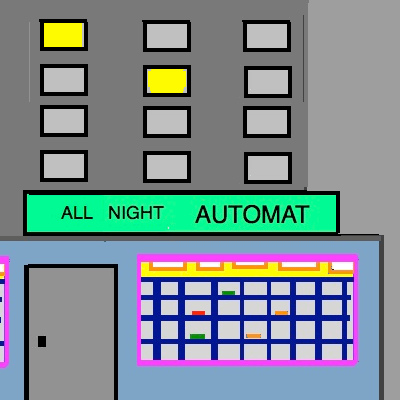
She decided to go into the automat by the Hotel St Crispian, which was where she took most of her evening meals, meager as they were. She could nurse a cup of coffee there and read her library book, and when she got hungry enough she could treat herself to some split-pea soup and a roll.


She would linger there as long as possible, switching from coffee to water so as not to toss and turn all night in bed anymore than she would normally do, which was a lot, and then finally she would head back to the wretched sweltering apartment on Jane street, to the blaring radio and the mindless chatter of her flatmates, to the stench of cigarette smoke and cheap perfume and unwashed linens…

The automat was crowded, as it usually was at this time, 7:30 in the evening. She got her cup of coffee and found a small table by the window which looked across the alleyway to the dirty brown brick walls of the Hotel St Crispian.


Missy Hallebrand was a petite pretty blonde-haired girl of twenty-two, like thousands of other girls in this swarming madhouse of a city, except she was not a happy girl. 

She wasn’t one of these laughing chattering idiots like the girls she worked with at Macy’s, or like Maddy, Teri, and Gerrie. 

She was a sad girl.

She opened her purse (black, plastic, cheap, all she could afford even with her employee’s discount at the department store) and took out her book. 


Thank God for the library and thank God for books.

Not that she believed in God.

“Excuse me, ahem, miss?”

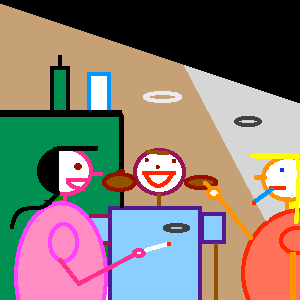
These words were spoken by a tall young woman with short dark hair and a panama hat with a wide red band, wearing a sleeveless and scoop-necked black pullover of what looked like real silk and pearl-colored pongee slacks. She had a large brown-leather bag on her shoulder, like something an army officer would carry maps in, and she had a tray in her hands.

“Is this seat taken?” said the tall girl.

“No,” said Missy. “It’s free.”


“Do you mind terribly if I sit? The only other empty places are at tables with men. I hate to sit at tables with men. They disgust me so.” She had some sort of southern accent, which seemed to Missy even more pronounced with the next thing she said, which was, after a short pause: “They’re so mean, so mean and hateful.”

“Please, sit,” said Missy.

“Thanks, doll.”

The girl sat down and put her tray on the table. The tray held a cup of coffee and a slice of what looked like the pineapple upside-down cake.


“Would you mind passing the cream?” she said.

The cream pitcher was no closer to Missy than it was to the other girl, but Missy had been brought up right, so she picked up the creamer and moved it three inches closer to the girl.

“Thanks,” the girl said, and she poured a couple of ounces of cream into her cup. She glanced in a meaningful-looking way at the sugar dispenser, but before she could say anything Missy slid it towards her. The girl picked it up, poured about four teaspoons worth of sugar into her cup, then picked up her spoon and stirred the mixture thoroughly.


Missy returned her gaze to her book, but before she could find her place the girl with the Panama hat spoke again.

“I wouldn’t mind it if the men were nice at all, but they are invariably so rude, and they all think they are God’s gifts to women. Don’t you find that to be true.”

“Yes, I suppose so,” said Missy.

“Don’t you find that men are always trying to pick you up when you sit alone in places like this?”

“Well, sometimes –”


“And what do you do about it? Do you let them pick you up?” The girl was eating her cake as she spoke now, along with taking little sips of her coffee, but, unlike Missy’s flatmates, she managed to perform all three actions in a manner that was not revolting, neither leaving crumbs on her lips nor making vile slurping noises. “Or do you tell them to take a hike?”

“I just tell them I have a boyfriend,” said Missy, “and then they usually leave me alone.”

“Oh,” said the girl. She put down her fork, picked up her paper napkin, and dabbed her lips, which were painted very red, and seemed especially red as her face was as pale as the paper napkin which she laid very neatly back onto her tray. She took another sip of her coffee, and Missy had just lifted her book to try to read again when the girl spoke, again: “And do you really have a boyfriend?”


Missy was beginning to be annoyed, but there was something about this girl – her pale skin, her red lips, her forthright manner, combined with the soft southern accent – that overcame, if only barely, Missy’s incipient annoyance. 

“I suppose I do,” she said.

“You suppose you do?” said the girl, and one of her eyebrows arched upwards a full inch. Her eyebrows were thin and dark, but they didn’t seem to be trimmed or shaven at all, and they were free of that awful tarlike paste most women smeared on theirs.


“Well,” said Missy, “the thing is, he’s away in the army.”

“Oh,” said the girl. “He’s in the army. Overseas?”

“Yes,” said Missy. “He was drafted, right out of law school, and he’s in Germany now.”

Germany,” said the girl, with an emphasis that made it sound like the name of a place much farther away, like the South Pole, or perhaps a space station orbiting Alpha Centauri. She took up her fork and set to work on her pineapple upside-down cake again. 


Missy returned her eyes to her book, but not with much hope of even beginning to read a sentence, and sure enough the girl spoke once more.

“How much longer is his hitch for? The boyfriend.”

“Oh,” said Missy. “At least another year I think.”

“Another year,” said the girl. “That’s a long time.”

“Yes,” said Missy.


“Oh, my name is Muriel by the way. Muriel Armitage.” She put down her fork and held out her hand. The fingers were long, slender and white, the nails were long and painted the same color as her lips. Missy took the hand, and the girl squeezed Missy’s hand with a rather strong grip for a woman.

“I’m Missy. Missy Hallebrand.”

The girl called Muriel gave Missy’s hand one more good squeeze, and then set it free.

“But I’ve been talking your ear off, and you’re trying to read your book.”

“I don’t mind.”


“I can’t help but notice it seems to be in French. What’s it about?”

“Well,” said Missy, “it’s about this man, a novelist who is a confirmed bachelor, and, in a moment of weakness, he proposes to this girl, and it seems as if he’s spending the rest of the book trying to get out of the engagement.”

“Oh, marvelous. Sounds like my kind of book. And what is his fiancée like?”

“Well, she’s sort of a drip, actually.”

“Ha ha, a drip. There certainly are plenty of them around. Drippy girls I mean.”

“I know.”

“Almost as many as there are drippy men.”

“Maybe even more,” said Missy.


“Ha ha,” said Muriel. “That is quite possible. What do you do.”

“You mean, what do I do for a living?”

“Yes.”

“I sell cosmetics at Macy’s.”

“How dreadful for you.”

“It’s not so bad.”

“It sounds bad.”

“Yes,” said Missy. “It’s pretty bad. But unfortunately there’s not many jobs for girls with degrees in French literature.”


“I daresay not.”

Muriel lifted her cup, this time using both of her long and slender scarlet-tipped hands, and as she sipped her coffee she looked at Missy. Her eyes beneath the brim of that Panama hat were brown, and deep. She used just a little eyeliner and mascara, although to be quite honest Missy thought she could give her a couple of simple pointers on their more correct application.

“What else do you do, Missy.”

“What else?”


“Yes. With your life. While you’re waiting for soldier boy to return from Germany.”

No one had ever asked Missy such a question before, and she was just a little taken aback.

What did she do with her life?

“I hope you don’t think I’m a Nosey Parker,” said Muriel. “I was only curious.”

Missy looked out the window at the dirty brown brick walls of the Hotel St Crispian.

“This is it,” she said. “I work at the cosmetics counter at Macy’s. I can’t stand to go home to my smelly hot apartment and my idiotic roommates, so I sit here in the automat and read a library book. If there’s anything good playing I may go to a movie. I take walks. I – I –”


“You what, honey?”

“I wait.”

“You wait.”

“Yes. I know it’s pathetic, but I wait –”

“Wait for what.”

“I wait for my – my boyfriend to get out of the army.”

“Oh.”

“You see, we’ve talked about – you know –”

“Getting married?” “Yes.”

“So you’re engaged.”


“No,” said Missy, after a pause that lasted longer than she wished it had. “We’ve only talked about it. Chad says –”

“Chad?”

“Yes, that’s my boyfriend.”

“’Chad.’”

“Yes. He says, he said, he says, we should wait, until he gets out of the service, before deciding, and, and –”

“And what, dear?”

“And maybe wait, some more, until he gets established, in his law career, before, before –”


“Oh, honey.”

“What?”

“Nothing,” said Muriel.

She had finished her pineapple upside down cake. She picked up her map case or whatever it was, opened it, fished around in it, and came up with an opened pack of Herbert Tareyton cigarettes.

“You smoke, honey?”

“No, not really,” said Missy.

“Take a Herbert Tareyton.”

“Why?”

“’Cause, honey, you’re gonna need one with what I am about to tell you.”

Missy hesitated for a moment, but then she took a cigarette after all, she had no idea why.


chapter 2: Chadwick


Tuesday, January 13, 2015

fun, part 7

by harold p sternhagen writing as "ralph desmond"

as originally appearing in the july-august 1951 issue of sinister destinies magazine

illustrated by konrad kraus

editorial consultant: Prof. Dan Leo

for previous episode of "fun" , click here

to begin "fun", click here


in our previous chapters, we met jerry and roselle winfield, socialites and slummers extraordinaire.

roselle has enticed the drifter "humphey p strawfeather" to help her murder jerry.

jerry has intuited that roselle intends to kill him.

and he seeks to locate his old army buddy "whitey" wilson to help him avoid this fate, perhaps by murdering roselle.

*


jerry had made up his mind to try to contact whitey wilson. he had his address in rochester from the woman in north carolina - mother or aunt or whatever she was.

bus, train, or take a cab all the way to rochester?

jerry was not even sure where rochester was. he knew it was west somewhere, away from the atlantic ocean. about as far as albany? further?

he decided to get a cab to the port authority. if a bus was leaving for rochester any time soon he would take it. if not, he would try penn station.


it was still raining. he stopped under an awning in front of a little grocery store. the window was made of thick green glass and hard to see through, but it was lit up indicating the store was still open. it seemed as good a place as any to hail a cab.

jerry took a deep breath, shook some rain off his hat and himself, and took out his cigarettes.

"take your time, lady."

there was one customer left inside the grocery store . harry, the sole owner and proprietor, was ready to close up, but he waited for her, not too impatiently, because he recognized her and she had always bought something before.


pandora wilson liked to shop. for everything. she liked to take her time when she shopped for clothes, when she shopped for food, when she went to the drugstore to buy toothpaste. when she went to the movies, it was always on 42nd street, where she could walk up and down and look at the billboards outside before deciding which double feature to see..

she even shopped for cigarettes, and never bought the same brand two times in a row.

now she was checking out the grapes in harry's market. she held a bunch up to the not very bright light.


besides shopping, pandora liked to talk, to anybody who would listen to her. she wondered if she should try to chat up the little guy who seemed to own the place. he looked like he was ready to close up. she had been in here a few times before, but always when it was busy and she had never had the chance to talk to him.

pandora saw something out of the corner of her eye. the windows of the store were thick glass but the door was clearer glass, and a man was standing in front of it.

his back was turned but it looked like the guy she had just seen in willa's cafe - the not bad looking, well dressed but kind of creepy looking guy who wanted the change for a long distance call.


she watched as he turned his head to look up the street - it was him!

was he following her? what a nerve! or maybe he was just waiting for a bus. pandora decided to challenge him - that would be fun.

she took the grapes that she had in her hand, and grabbed a couple of bananas she had checked out before, and went over to pay for them.

"we meet again, " said a voice behind jerry.

he jumped almost a foot. my nerves must really be shot, he thought as he turned around.


the voice belonged to the fat woman from the cafe, the one in the pink sweater, which was now covered up by her coat.

pandora was a little disappointed - and a little relieved - by the genuine surprise she saw on jerry's face, but she still asked, "are you following me?"

"uh - no." jerry, recovered from being startled, did not even look annoyed by the question. he turned to look back up the street.

"waiting for a bus?"


"no."

"then why are you standing out here - if you don't mind my asking?"

if i don't mind her asking. what idiots people were, thought jerry. "no, i'm waiting for a cab."

"oh, you'll never get a cab here."

"it's west end avenue."

"yes, but there are never any cabs on this stretch, especially at this time of night."

"you don't say."


"yes, it's a well-attested fact. you could look it up in the world almanac. city planners and scientists alike are baffled by the phenomenon."

jerry looked up the street, into the rain. it was kind of strange that no cabs had come along.

he turned back to pandora. "so you know a lot about cabs, hey?"

"you might be surprised at what i know."

"how much would a cab to rochester cost?"

pandora considered the question. "rochester new york?"


"yes. are there any other rochesters?"

"of course. there are thirteen rochesters in the united states alone, not counting two east rochesters."

jerry stared at her. the rain continued to beat on the awning above their heads. "thirteen, huh? pretty unlucky."

"yes, there is rochester vermont, rochester ohio..."

"all right, i believe you. do you know how far rochester new york is - approximately?"

"i know exactly how far it is - 335 miles."


"oh. so how much would a cab cost ? if i could find one that would take me."

"well, in the first place, they might not even be licensed to do it."

jerry laughed. "that might not be a problem."

"well, they would want about twenty cents a mile for 335 miles plus they have to drive back so call it forty cents - that is what, about $265. "

jerry thought about that.

"you have $265 on you?" pandora asked.


"i might."

"then i know someone who might help you out."

"oh?"

"who will do it for a flat $250. including gas."

the door opened behind them and the owner of the store stepped out. he was wearing a raincoat and a fisherman's rain hat and carrying a pole to roll up the awning.

"sorry, folks."


"no problem," jerry told him, as they he and pandora stepped aside. "you know what i need?" he asked pandora. "even more than a cab?"

"no, what?"

"a drink. and look, there is a bar right across the street. why don't we continue this discussion over there?"

***

"all right, so you just happen to know someone who will drive me to rochester - rochester new york , not rochester vermont - for the princely sum of $250?" jerry felt much better after knocking back a double bourbon and ordering another.


he and pandora were sitting across from each other in a booth at the back of the bar across the street from harry's market.

"yeah. me," pandora told him.

jerry was not surprised. "so you have a car?"

"no, but i can get one."

jerry hesitated. "you're not going to steal one?"

pandora laughed. "hell no, i'm not going to steal one. i can borrow my uncle randy's car. he will let me use it. i might even slip him a few bucks."


"the car works all right?"

"i guess. consider this. it's not a cab. if you were in a new york cab in the middle of the night on the highway somewhere in the adirondacks you think police aren't going to be stopping you, just out of curiosity?" pandora tried to look jerry right in the eyes through the smoke of their cigarettes. "you wouldn't want that , would you?"

"no. i guess not."

the bartender brought jerry's second double bourbon.


when he had left, pandora asked, "so what is your big hurry to get to rochester anyway? you sound like you never even been there, if you didn't know where it was or how far away it was."

"an old army buddy of mine lives up there."

"and you just got this sudden urge to see him? you can't just take the train or plan your own trip? not that it's any of my business."

"i just found out he's dying. he - he was in a motorcycle accident. i want to see him before he dies."


"that shows you got a good heart," pandora smirked. "let me guess - you saved each other's lives fifteen times in the war."

"no, we were in a supply company - here in the states."

"supplies?"

"yeah, all sorts of stuff, but our specialty was socks and underwear."

"and now you work at macy's. that's why you dress so nice."

"not exactly." jerry flushed a little. the liquor was getting to him.


pandora laughed. "you are honest about the war anyway. so many guys will tell you all about how many japs they threw over their shoulders with bayonets."

suddenly jerry thought - how do i know this - this whatever she is - isn't going to drive me out into the middle of nowhere and shoot me and dump my body by the side of the road?

he remembered a line in a movie he saw somewhere - or maybe he read it in a mystery novel -

"when you start thinking about murder, you start seeing murder everywhere."

a chill ran down his spine and sobered hm up - for about seven seconds.

he finished the second bourbon and got up from the booth to order another one.

part 8


Wednesday, January 7, 2015

“El Jefe’s Biggest Bet”

by Horace P. Sternwall

Originally published in “Cracking Adventure Stories”, January, 1951; reprinted for the first time ever in They Call Me Cigarillo Sid: The “Cigarillo Sid” Stories of Horace P. Sternwall, Volume One; the Olney Community College Press.

edited by Dan Leo, Horace P. Sternwall Professor of Demotic Literature, Olney Community College.

illustrated by rhoda pnmarq for “penmarq™ multigalactic productions”.  


Monday night was poker night in the rooms of the science fiction writer Fred Flynn (Target: Earth; Starship Mutiny; Revolt in Galaxy X, etc.) at the Hotel St Crispian, and the other three regulars were also gentlemen of letters: Harold P. Sternhagen (author of Belle of the Bayou; My Gun Has No Conscience; Sixth-Floor Walk-Up, etc.),

the noted playwright Mr. Angus Strongbow, (Hail the Conquering Loser; Ask Not the Stars; Nero’s Fiddle, etc.),

and perhaps the most prolific member of the little band, if not the most successful, Horace P. Sternwall (Cattle Queen of Brooklyn; The Beauty from Baton Rouge; Journey to Lesbos, etc.).

Being storytellers, it was only natural that the four friends should swap yarns while they played their nickel-and-dime hands of stud and draw poker, and one night the subject of “real” gamblers came up.


“I knew a real gambler once,” said Horace. “I’ll bet a nickel.”

“We’ve all known ‘real’ gamblers,” said Angus. “See your nickel.”

“Yeah, even me,” said Fred. “Like this guy Tommy Sullivan. I’ll go for a nickel, by the way –”

“You knew Tommy Sullivan?” said Angus.

“Yeah,” said Fred. “I mean, I, you know, saw him around, because he was living here in the hotel for a while, before he, uh –”

“Before he got bumped off,” said Harold.


“To put it bluntly,” said Fred. “You in, Harold?”

“In for a nickel,” said Harold.

“Tommy Sullivan wasn’t a ‘real’ gambler,” said Horace.

“What do you mean?” said Fred. “That guy was notorious. I know for a fact that he would host games up in his suite in this very hotel where the pot got as high as fifty grand.”

“That’s a lot of dough, I grant you,” said Horace. “A lot of dough. But I still say he wasn’t a real gambler. I knew a ‘real’ gambler.”


They called him Cigarillo Sid {said Horace}, and he was the last of the last of the old-school gamblers.

Sid didn’t own a house or a car, and he traveled the country by train or by bus, living in hotels or motels or rooming houses.

If he was flush he traveled in a Pullman car, if he was busted he traveled by boxcar or by his thumb, and if he was somewhere in between he went by Greyhound.

He always kept an icepick in his left boot – he wore these old cowboy boots you see – and a straight razor in the inside breast pocket of his suit coat.


He never carried a gun, though. Sid always said guns were trouble, and he didn’t need a gun, anyway. He could do more damage with that straight razor and that ice pick than most guys could do with a .45 or even a shotgun. Not that he didn’t know how to use a gun if he had to, you understand...

I first met Sid one day over at Bob’s Bowery Bar, down at Bleecker and the Bowery. You guys know the joint. Nothing fancy about it, but the house bock (which Bob brews himself in the basement) is good and cheap, and so is the food, good hearty fare cooked by the taciturn old woman known as “Bob’s mom”. Is she really Bob’s mom? Who the hell knows, and who cares, anyway? 


At the time I’m talking about I was just getting started out in the writing game, churning out stories for the pulps at the rate of two or sometimes even three a day, and I had a cold-water shotgun flat on the sixth floor of the same corner building that housed Bob’s bar. That flat was as cold as Iceland in the winter and as hot as Borneo in the summer, so I spent a lot of time downstairs at Bob’s, where a nickel could buy you a glass of that delicious house bock and a quarter would get you a filling and nutritious bowl of “Mom’s” famous Mulligatawny stew. I would write out my stories longhand in those black-and-white marble copybooks, and then type them up later in my flat. I would have brought my second-hand Royal down to the bar, but Bob didn’t like the noise.


Bob’s was no fancy joint by any means, but Bob ran what he liked to call a “taut ship”. No foul language, no shouting, and any misbehavior at all and he’d bring his trusty old leather sap down on your skull before you could say Jack Robinson.

Bob didn’t like music either, so there was no jukebox, and no radio. (This was before the days of television, but even when TV sets became ubiquitous Bob refused to install one, and he still won’t have one in his joint to this very day.) So even when the place was packed it was never noisy, and a good place to write one’s deathless prose.


Anyway, one cold Friday afternoon in February I was sitting by myself at one of the booths scribbling away in my copybook and nursing my bock when this skinny little old guy in a ten-gallon Stetson said, “’Scuse me, young fella, you mind if I sit here? Ain’t another seat free in this saloon, and I’m getting too old to stand up and drink.”

“Sure,” I said, because who am I to hog a booth all to myself, and anyway, I was a writer, and something told me I could get a story from this character. Which turned out to be true.

The old guy slid in across from me and introduced himself.


“Sid’s the name. They call me Cigarillo Sid.”

Sure enough he had a cigarillo in one hand, and in the other was a schooner of what looked like Bob’s basement-brewed bock.

“Horace is my name,” I said, and I took the wiry old hand he offered. “Horace P. Sternwall.”

“What’re ya writing there, Mr. Sternwall? You don’t mind my asking.”

“Call me Horace, old-timer,” I said.

“Horace it is,” he said. “And you for your part may address me as ‘Cigarillo’.”


“Pleased to meet you, ‘Cigarillo’,” I said. “And to answer your question I’m writing a short story tentatively called ‘Tie My Noose Tight, Baby’.”

“You write for the magazines then?” he said.

“That I do, sir,” I said.

“’Cigarillo’,” he said.

“’Cigarillo’,” I said.

“I could tell you a million stories,” he said.

“I believe you could, Cigarillo,” I said.


“You see,” he said. “I’m a gambling man. Always been a gambling man, since I left home at the age of fourteen. Gambled all over this country, Canada too, all the way up to the Yukon and Alaska. Down through old Mexico and Central America and all the ways down to Panama City. In fact it was down in Panama City I got in the game of my life.”

“That so?” I said.

“I been in big games,” he said. “But this was the biggest one.”

“How big was it?” I asked.


“As big as a game can get. Stud poker was the game and it came down to me and this old boy they called El Jefe. We had ninety-two thousand American dollars piled up on that table. This El Jefe, great big fat Panamanian dude he was, smoking a great big fat Cuban cigar. Me smoking my usual little Robert Burns cigarillo. El Jefe had a pearl-handled revolver under his tropical white suit jacket; me, I had a straight razor and an ice pick. You want to see ‘em? I’m carrying them right now.”

“That’s okay, Cigarillo,” I said.


“Anyways it gets on near five a.m. and you could hear the cocks crowing, and coming through the curtains was them first faint glimmerings that mean another day is about to come, like it or not, ready or not. Now I admit I was getting tired, on account of we’d been playing like thirty-six hours straight at that point, and I guess old El Jefe was getting tired too, because he says, ‘One more hand amigo, for everything on the table.’

“’Sure, El Jefe’,” I says. ‘I’m game.’

“’But basta with this stud poker,’ he says. ‘We’re gonna shuffle a new  deck, cut it, and draw two cards. High card wins the pot.’


“’Shuffle ‘em up, chief,’ I says.

“’But I ain’t finished,’ he says. ‘High card wins the pot, but low card gets this.’ And he pulled that pearl-handled six-shooter out of his shoulder holster and lays it on the table.

“’Loser wins the pistol?’ I says.

“’No, amigo,’ he says. ‘Loser puts the muzzle of this Colt New Service to his head and pulls the trigger.’

“’That’s some bet,’ I says.

“’There ain’t no bigger bet,’ he says.


“Now I should mention here they was three of El Jefe’s boys sitting in chairs in that room, watching the game. Three mean-looking boys. Stone-faced they was, like they’d seen El Jefe make this bet before. And every one of them boys was packing iron under their tropical white suit-jackets too, and not making no effort to hide it, neither.

“’Or, Señor Cigarillo,’ says El Jefe, ‘you can get up and leave now. Except the dinero stays right where it is on the table.’

“What can I say, Horace?” said Cigarillo Sid. “I’m a gambler. I had never walked away from a game before and I wasn’t about to start then.


“’Like I said, El Jefe,’ I said. ‘Shuffle ‘em up.’

“Old El Jefe gave me a good long look, and the he snapped his fingers and one of his boys came over and gave him a fresh pack of cards. El Jefe broke the deck open, then shuffled ‘em up, shuffled ‘em up good, then clapped the deck down on the table. 

“’Okay, Señor Cigarillo,’ he says. ‘Cut.’

“And I cut the deck. 

“By this point all three of El Jefe’s boys were standing next to the table, to my right, and they all had their white suit jackets open, with their pistol-butts showing in shoulder holsters just like El Jefe’s.


“’You want to draw first?’ says El Jefe.

“’Hell, El Jefe,’ I says, ‘I’m a guest in your fair country. You draw first.’

“El Jefe give me another one of them long looks, but then he draws a card, looks at it, and lays it down on the table.

“’King,” he says. ‘King of hearts, Señor Cigarillo.’

“’That it is,’ I says, which was true, Horace, it was a king of hearts all right.

“Well, it was too late to get up and walk out by then, so without thinking about it a whole hell of a lot I drew a card and without even looking at it I threw it down face up on the wood.


“And you know what that card was? An ace it was, Horace, an ace of spades.”

“Wow,” I said. “So what happened, Cigarillo? Did El Jefe shoot himself in the head with the pistol?”

“Nope,” said Cigarillo. “I can’t say he did. But to be truthful I didn’t give him a chance to. He reached for it but I was quicker. I already had my icepick in my left hand and quick as a flash I impaled El Jefe’s fat mitt to the table with it and then with my right hand I picked up that pistol and put a bullet in between the old boy’s eyes. Then as he slumped onto the table as dead as he was ever going to be I looked at his three boys who all had their mouths open and their pistols out and pointed at me,


  and I said, I says, ‘Amigos, looks to me like you boys are out of a job. Now you can fire them pistols, but if you do I’m betting I can take at least one of you with me. Now who wants to bet they’re not gonna be the unlucky one?’

“I guess none of them took the bet?” I said.

“You’d be guessing right, Horace,” said Cigarillo Sid. “Them boys weren’t dumb, and they weren’t gamblers neither. But I left them a grand apiece, which was probably a hell of a lot more than El Jefe was going to pay them for the night’s work.”


“That’s some story, Cigarillo,” I said.

“I got a million of ‘em,” said Cigarillo Sid.

“I’m sure you do, Cigarillo,” I said.

“For the price of another schooner of this here bock beer I’ll tell you another one,” he said.


“So did you buy him a another bock, Horace?” said Fred.

“Damn straight I did,” said Horace, “and five or six more after that. And every one of them I sold to the pulps. I’ll take two cards, Fred.”

“Two cards it is,” said Fred.